Backwater valve installation in Calgary: what the job actually involves
Written for Calgary homeowners
Something has pushed you to this: a basement that took on sewage once, an insurer asking the question, or a basement development where the inspector wants backflow protection before the floor is closed up. Either way you are buying a job that is mostly concrete and excavation with a small part in the middle — and the quotes will vary wildly.
Short answer: In Calgary, installing a backwater valve is a permitted plumbing job, not a parts swap. A plumbing permit is required to install a back-flow prevention device, the work falls under Alberta's compulsory certification rules for plumbers, it gets inspected — and the rough-in inspection has to happen before the concrete goes back. One normally-open valve may only serve one dwelling unit. And there is no City of Calgary rebate to offset any of it.
Sources: The City of Calgary — Climate-ready measures: water management (permit required for a back-flow prevention device); The City of Calgary — Trades permits; Alberta Tradesecrets — Plumber.
How current this page is. Every hard fact below is cited to its primary source — the City of Calgary, Alberta Tradesecrets, or the City's plumbing advisory — and those sources were last opened and confirmed by us between 19 and 23 September 2026. This week's pass could not re-open them, so we are saying so rather than implying a fresh check. Permit fees change every 1 January: confirm any figure with 311 before it goes in your budget.
Three places the valve can go, and each one is a different job
This is the fork that decides your price, your timeline and sometimes who is allowed to hold the shovel. Work out which of the three applies before comparing quotes, because two companies pricing different versions of the job will never agree.
1. Inside, under the basement slab
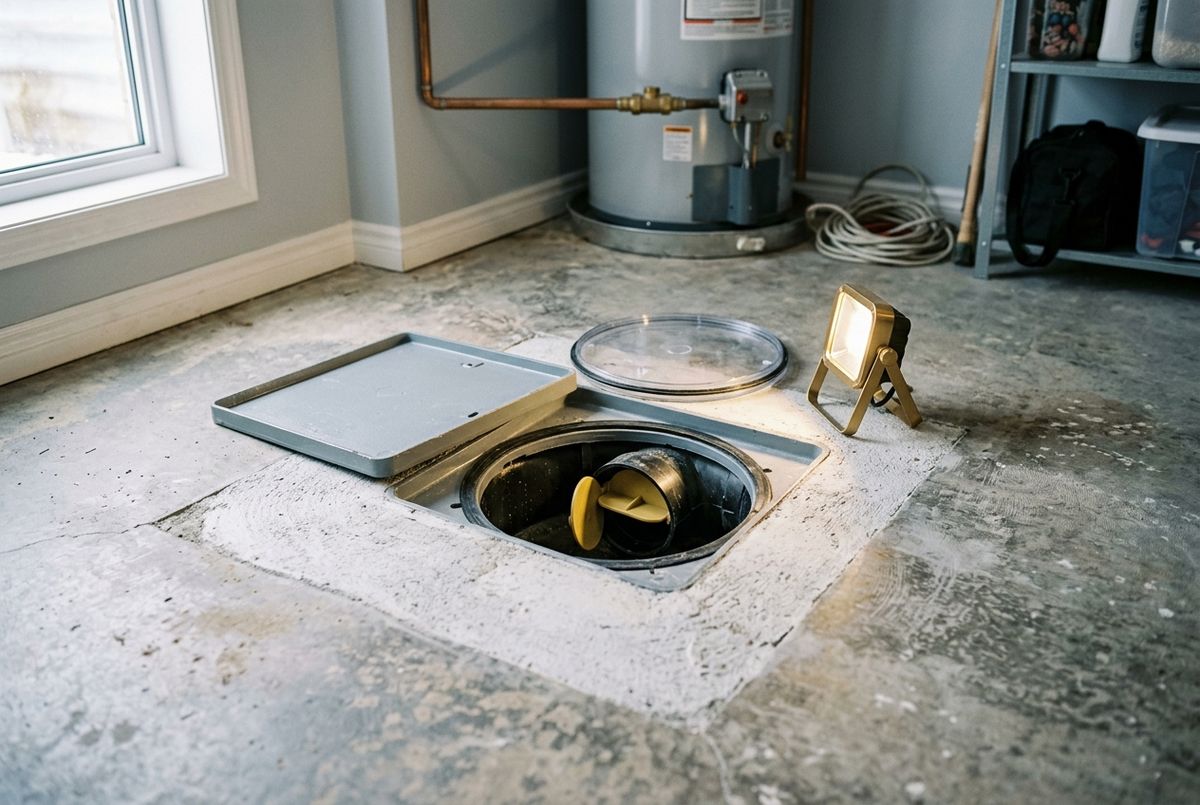
The common retrofit. The valve goes into the main building drain on the street-facing side, near the existing cleanout: saw-cut the floor, dig out around the pipe, cut in the valve body, set an access box flush with the finished floor, backfill and re-pour. The benefit is access — a valve you can reach in your socks in February actually gets serviced, and a serviced valve is the only kind that closes when it matters.
What drives the number is what sits on top of the slab and how deep the pipe runs — the full list of cost drivers is on the rebate page.
2. Outside, on your own property
Your floor stays intact, which after a finished basement is worth real money. The trade-off is an outdoor excavation in a city with a hard frost season, so it has a window rather than a date — and the valve ends up in a yard chamber you still have to open every year. Ask exactly where before the landscaping goes in.
3. Outside, and the dig crosses into the City's right-of-way
If the valve has to go beyond your property line — boulevard, sidewalk, lane or road — the job stops being a plumbing job and becomes a roads job with plumbing in it. An Excavation Permit is required to break or dig into the surface of a City of Calgary road right-of-way, restoration falls on the permit holder, and the permit holder carries the trench backfill obligation for two years — in a freeze–thaw city, that is not a footnote. Under the Tree Protection Bylaw (23M2002) a tree protection plan is also required for work within six metres of a public tree in the right-of-way, which routinely covers the whole front yard of an inner-city lot.
Sources: The City of Calgary — Excavation permit; Excavation Permit Terms and Conditions; The City of Calgary — Tree protection bylaws.
Those rules are written up in full on sewer line repair, including the City's utility indemnified contractor requirement. If your valve is going past the line, read that first: the question is not "are you licensed" but "are you on the City's list, and who holds the excavation permit."
What the code is actually asking for — and what it is not
There is a difference between protecting the whole house and protecting the fixtures actually at risk, and it changes what you should be buying. The City's plumbing advisory points at the National Plumbing Code 2020, which requires fixtures located below the level of the adjoining street and subject to backflow to be protected (s. 2.4.6.4). The trigger is the fixture, not the house: a basement bathroom, laundry or floor drain below street level is what the code is worried about. That is why a mainline valve is not the only possible answer, and why your inspector may accept protection arranged differently.
The same advisory carries the rule that catches people mid-renovation: a normally-open backwater valve may only serve one dwelling unit. A legal secondary suite is a separate dwelling unit, so one valve cannot cover both, and existing shared installations may need to be removed, reconfigured or supplemented. If a suite is anywhere in your plans, read the suite page before the slab is cut.
Source: The City of Calgary’s plumbing advisory on secondary suites, backwater valves and protection from backflow (4 October 2022). The advisory states on its face that it has no legal status and cannot serve as an official interpretation of the codes in effect — so treat it as a signal of how the City is thinking, and confirm your own job with 311 or the City's Technical Assistance Centre.
The permit, in whose name, and who may legally do the work
A plumbing permit is required when a plumbing system is constructed, extended or altered — cutting a valve into your building drain is an alteration — and the City separately states a permit is required to install a back-flow prevention device. No permit is required to repair a leak or clear a blockage, so if anyone tells you a valve retrofit rides along under "repairs", that is not what the City's list says.
Who pulls it depends on who does the work. A homeowner's plumbing permit is $112 plus a $4.50 Safety Codes Council fee — $116.50 — and needs all three of: you own the home, you live in it or intend to, and you do the work yourself. A contractor trade permit is $112 processing plus $9.79 per $1,000 of construction value, with the same $116.50 floor. Fees rise every 1 January.
Sources: The City of Calgary — Trades permits; Building and trade permit fee schedule. Last confirmed 19 September 2026, when no increase had landed.
Plumber is also a compulsory certification trade in Alberta, so the restricted work belongs to journeyperson certificate holders and registered apprentices. The homeowner exemption covers property you own, possess or control and intend "only for personal and not-for-profit use" — wording that, on our reading, probably does not stretch to a suite you intend to rent. That is a reading, not settled law. More on where the line sits in what you can legally do yourself in Alberta.
Sources: Alberta Tradesecrets — Plumber trade profile; Classes of individuals exempt from certification.
The sequence on the day — and the one step that costs money to get wrong
- Camera the drain before anything is cut. Cracked clay or root intrusion means a repair conversation first — and who owns that section of pipe decides who pays.
- Agree the exact location, thinking about year ten. The cover has to stay reachable: not under the deep freeze, the planned bathroom tile or a future stud wall. Mark it on the floor before the saw comes out.
- Permit in hand before the slab opens, in the name of whoever is doing the work.
- Saw-cut, excavate, cut in the valve — flow direction right, access box set so the lid finishes flush with the floor.
- Rough-in inspection while it is still open. The step that costs money when it slips. Calgary requires a rough-in and a final, someone 18 or older present, booked through 311 or VISTA — next-day requests by 2 p.m. Re-pour first and you may be breaking your new floor to show them.
- Backfill and re-pour to the standard you bought — patched and restored-to-finished are different line items.
- Final inspection, then diarise the annual service — cover off once a year, flap clean and swinging freely.
Source: The City of Calgary — Plumbing and gas permits (rough-in and final inspections; 311 or VISTA; next-day requests by 2 p.m.).
What a backwater valve will not do for you
Worth being plain about, because it gets sold as flood protection generally, and it is not.
- It does nothing about groundwater. Seepage through foundation walls or up under the slab never touches a sewer valve — that is sump pump work, and where the discharge may legally go is regulated more tightly than most people assume.
- It does not move responsibility to the City. Basement flooding is the homeowner's responsibility; the City will assess the situation but does not pump water out of basements. If sewage backs up, 311 is still the first call — and if it is happening right now, start with what to do in a plumbing emergency.
- It does not settle your insurance. Whether a valve changes your coverage or premium is a question for your own policy — one Alberta brokerage notes clogs and high water pressure tend to be treated as maintenance and likely not covered, which is an argument for servicing it annually.
Sources: The City of Calgary — Basement flooding and seepage; Sewage backups; Climate-ready measures; Acera Insurance — that brokerage's own statement, not a rule binding every insurer. Read your policy.
The quote: what has to be on the paper before you sign
We will not publish an install price, and we would be sceptical of any Calgary page that does: there is no authoritative public source for this work, and every figure online is a company's self-report about a job priced by a floor nobody has looked at. For labour alone, plumbers around the city publish roughly $85–$120 an hour for independents and $95–$150 for companies, after-hours higher — see what Calgary plumbers charge.
Source: rates as published by a Calgary plumbing company (updated December 2025), last confirmed 16 August 2026. A self-report, not a market rate — planning context only, not a quote.
What to insist on instead of a phone number:
- The device, named. Make, model, and whether it is a normally-open mainline valve or protection at the fixtures — so you can check it against the dwelling-unit rule yourself.
- The permit, included and in whose name, plus both inspections and who meets the inspector.
- The concrete, specified — patched, or restored to a finished surface, as a priced line.
- A camera before and after. Before, so you know the pipe is worth a valve; after, so you know what was left behind.
- Right-of-way obligations, if the dig passes your line: who holds the excavation permit, who restores the surface, who carries the two-year backfill maintenance.
- What happens if the camera finds a problem — in writing, so a sewer repair does not appear mid-job at a number nobody discussed.
Two timing notes worth money. If you are already developing the basement, do the valve while the floor is open — basement bathroom plumbing runs through the sequencing. And a sewer scope before you buy tells you what a retrofit will involve while you still have negotiating room. For the wider picture, start at our main Calgary plumbing guide.
Want to know what this looks like in your basement?
We will find where your drain runs, camera it before anyone talks about cutting, tell you which of the three installs applies, and put a written fixed price on it — permit, inspections and concrete included. If your line needs work first, you hear that up front, not as a change order halfway through.
Questions Calgary homeowners actually ask
The plumber says it's a half-day job. Why does it need a permit at all?
Because the City treats a backwater valve as a back-flow prevention device, and installing one of those needs a plumbing permit. It is also, physically, an alteration to your building drain — and the City requires a permit when a plumbing system is constructed, extended or altered. A half-day job can still be a permitted job.
Where people get tripped up is the opposite rule. No permit is needed to clear a blockage or repair a leak, so if somebody tells you your valve retrofit falls under "repairs", that is not what the City's own list says. The permit is not expensive relative to the concrete work, and it buys you an inspection by someone with no stake in the invoice. That is the part worth having.
We already have a valve in the main drain. Is the basement suite covered by it?
Probably not, and this one catches a lot of Calgary homeowners mid-renovation. The City's plumbing advisory says a normally-open backwater valve may only serve one dwelling unit, and a legal secondary suite is a separate dwelling unit. One valve, two units, does not add up.
That can mean an existing shared install has to be removed, reconfigured, or supplemented before a suite passes. It is cheaper to find that out while the floor is open than after the tile is down — we wrote the suite side of it up separately.
Inside the basement floor or outside in the yard? Which should I be asking for?
Mostly it is decided for you by where your drain runs and how deep it sits, not by preference. Inside means saw-cutting the slab, digging out, setting the valve, and re-pouring — messy but contained, and you can get at the thing afterwards in slippers in February. Outside avoids cutting your floor, but it is an excavation in a city that freezes, so it has a season.
The question that actually matters is whether the dig crosses your property line. The moment it enters the City's road right-of-way — boulevard, sidewalk, lane — a different set of rules lands on the job, and the quote should say who is carrying them.
Can I put one in myself? I've done my own rough-in before.
Maybe, and the test is not how handy you are. Alberta makes plumber a compulsory certification trade, so the restricted work is for certificate holders and registered apprentices. The carve-out is for property you own, possess or control and intend only for personal, not-for-profit use. A homeowner's permit in Calgary needs all three of: you own the home, you live in it or intend to, and you do the work yourself.
So if the basement is going to be rented, read that "not-for-profit use" wording carefully — our reading is that it probably does not cover you, but that is a reading, not settled law. Confirm it with Alberta Apprenticeship and Industry Training before you buy a valve, and remember the inspections still apply either way.
Does the City pay for any of this? My brother-in-law in Edmonton got money back.
He did, and you will not. EPCOR runs a backwater valve subsidy of up to $800 for Edmonton homeowners. As of August 2026 Calgary has nothing equivalent for a residential valve or a sump pump — the City's only stormwater incentive is a developer program.
It is worth phoning 311 before you spend, because that is a negative claim and programs do launch. But do not let a quote lean on a rebate nobody can send you a link to.
Once it's in, am I done worrying about the basement?
About sewage coming back up the main, you are much better off. About water generally, no — a backwater valve is a one-way gate on your sewer, so it does nothing about groundwater coming through the walls or up under the slab. That is sump pump territory, and the City's own advice is to replace a sump pump every ten years or sooner.
Two other things to keep in your head. While that flap is shut against a surcharging main, your own waste has nowhere to go either, so a backup in the street is still a stop-using-water event until it clears. And it is a moving part under your floor: open the cover once a year and check the flap is clean and swings freely. An unserviced valve that cannot close is the same as not having one.