Why your water pressure is low, and how to work out what's causing it
Written for Calgary homeowners · Last reviewed August 16, 2026
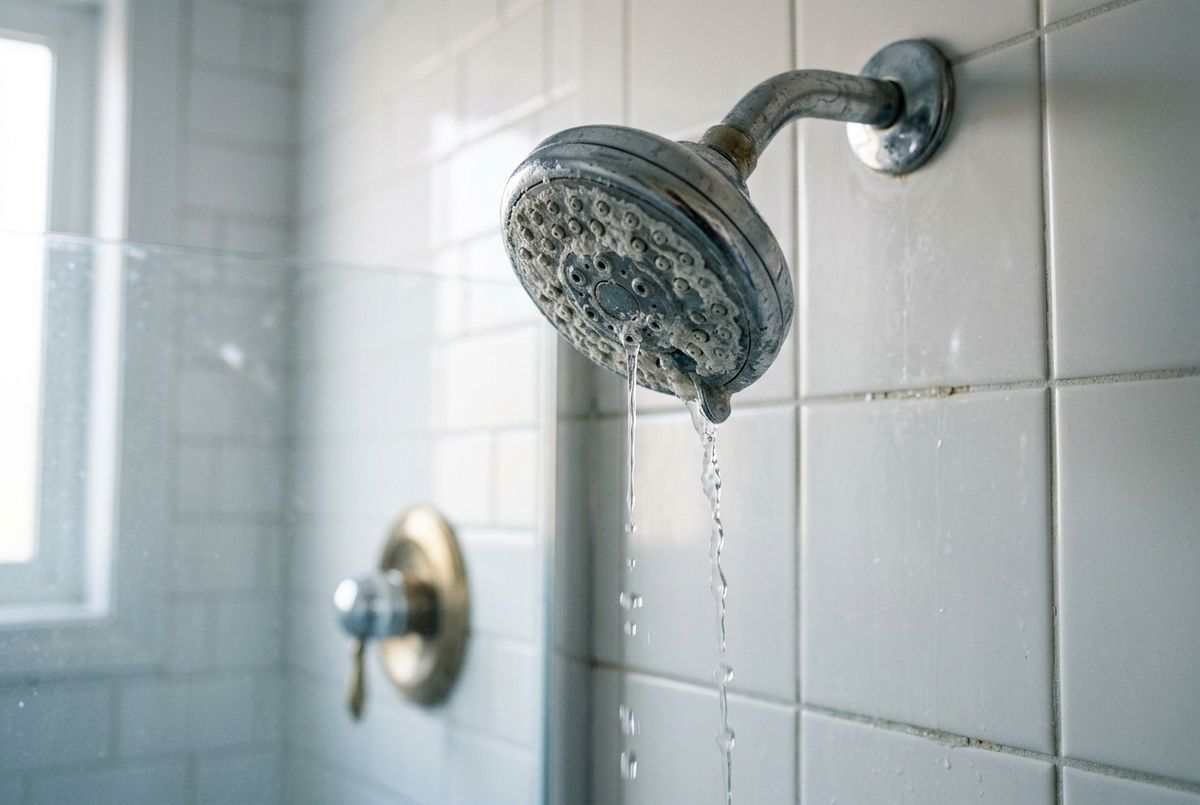
Short answer: before anything else, answer one question — did the pressure drop suddenly, or has it faded over years? A sudden drop is a valve, a failed pressure reducing valve, a leak, or something happening on the City's side of the property line. A slow fade over five or ten years is almost always your own pipes closing up from the inside, which in Calgary usually means galvanized steel supply lines in a pre-1960 house. Those two answers lead to completely different repairs and completely different bills.
Almost every article on this topic gives you the same undifferentiated list of nine possible causes and leaves you to sort it out. The sudden-versus-gradual split does most of the sorting for you in about ten seconds, so start there and work down whichever branch you're on.
It dropped suddenly
Something changed. Work outward from the cheapest and most likely.
- Ask a neighbour. Seriously, first. If their pressure is down too, it isn't your plumbing — it's the distribution system, and no plumber can help you. Crews work on mains, hydrants get flushed, a break upstream drops a whole run of houses. Call 311 and save yourself a service call.
- Check your main shut-off is fully open. In most Calgary homes it's in the basement on the wall facing the street, often near the meter and within sight of the water heater. A gate valve that got closed a couple of turns during a furnace service, a renovation, or the last time somebody fixed a tap is one of the most common causes of a sudden drop, and it's a free fix. Quarter-turn ball valves should be in line with the pipe; round handle valves should be wound fully open, then backed off a quarter turn.
- Check the pressure reducing valve, if you have one. Not every house does. It's a bell-shaped brass fitting on the incoming line, usually within a metre of where the pipe enters the basement, with an adjusting screw and locknut on top. PRVs fail, and the common failure mode drops your pressure across the whole house and keeps it down. It's a replaceable part, not a house-wide problem.
- Rule out a leak. Shut off every tap and appliance, then watch the flow indicator on your water meter. If it's still turning, water is going somewhere — possibly the buried service line between your property line and the house, which can pull pressure down without ever showing itself indoors.
- Check whether it's hot only, cold only, or both. Weak hot water alone points at the water heater's shut-off, a partially closed valve on the tank inlet, or sediment — not your supply. Weak on both sides means it's upstream of the tank.
Leave the curb stop alone
The valve under the small metal cap out near your sidewalk is the water service valve. The City of Calgary owns it, and neither you nor your plumber may legally operate it — it sits essentially at the property line, on the City's side of the split. If you suspect it's partly closed, that's a 311 call. Prying the cap off and having a go is how people turn a pressure complaint into a City repair bill.
Source: The City of Calgary — Water service lines. More on who owns which pipe.
It's faded over years
Nobody notices this one until they stay somewhere else and remember what a shower is supposed to feel like. Gradual loss means the inside diameter of your pipes is shrinking, and there are two mechanisms doing it.
Galvanized steel, closing from the inside
Calgary grew in distinct waves and each one left a plumbing signature. Inner-city homes built before roughly 1960 — the older parts of the northwest and southwest, the established communities close to downtown — frequently still have galvanized steel supply lines. Galvanized rusts internally, and the corrosion builds inward in layers rather than eating outward. A three-quarter-inch pipe can end up with a quarter-inch of usable opening while looking completely intact from the outside. If you are not sure that is what you have, the magnet test takes five minutes — see what your Calgary home's pipes are made of, which also covers the City's own identification method and what the public pipe map does not tell you.
The tells, beyond the slow fade: rusty or brown water from both hot and cold taps, worst first thing in the morning or after a week away; pressure that collapses when a second fixture is opened; and threaded joints that look furred and crusty where they meet. If the hot water is discoloured but the cold runs clear, that's the water heater rather than your piping — that's a tank-age question.
What fixing it involves is worth understanding before anyone quotes it. Repiping means running new copper or PEX from the main to each fixture group, which means opening walls and ceilings along those runs, and it's usually done in phases — the main trunk and the bathroom first, kitchen and laundry after. Two honest points: a partial repipe that leaves galvanized branches in place gives you a partial result, and drywall repair and paint are frequently quoted separately, so ask specifically whether they're in the number. This is a plumbing-system alteration, which as of August 2026 means a plumbing permit is required.
Source: The City of Calgary — Plumbing and gas permits. See also what you can legally do yourself in Alberta.
Hardness scale at the fixtures
The second mechanism is our water. Calgary's supply ran roughly 141–200 mg/L of calcium carbonate from the Bearspaw plant and 181–274 mg/L from Glenmore across 2025 — about 8–12 and 11–16 grains per gallon respectively, converting at 17.1 mg/L per grain. That's hard to very hard, and it builds up wherever water passes through a small opening: aerator screens, shower heads, mixing cartridges, appliance inlet screens and solenoid valves.
Source: The City of Calgary — Water quality and water hardness data. Conversion to gpg is ours. Full seasonal figures for both plants →
What scale does not generally do is close up modern copper or PEX supply lines the way people imagine. If your house was built after about 1970 and the pressure has faded everywhere, look harder at the PRV and at a partly-closed valve before you accept a repiping quote.
One fixture or the whole house?
The other split that saves you money. Test it properly: run the kitchen cold, then a bathroom cold, then an outdoor tap, and note which are weak.
| Pattern | What it points at | Who fixes it |
|---|---|---|
| One tap weak, everything else fine | Scaled aerator, then the mixing cartridge, then the shut-off under the sink | You, usually. Vinegar and ten minutes. |
| One shower weak | Scaled shower head, then the shower cartridge or pressure-balance valve | You, then a plumber if the head isn't it. |
| Hot weak everywhere, cold fine | Tank inlet valve partly closed, or heavy sediment in the tank | Plumber. See hot water diagnosis. |
| Whole house weak, all fixtures | Main shut-off, PRV, service line restriction or leak, or galvanized piping | Plumber — after you've checked with the neighbours. |
| Whole house weak and neighbours affected | Distribution main, hydrant flushing, or a break upstream | 311. Not a plumber. |
| Fine until a second tap opens, then collapses | Restricted supply — undersized or corroded main line into the house | Plumber. This is the classic galvanized signature. |
Pressure and flow are not the same thing, and conflating them sends people down the wrong path. Pressure is the force behind the water; flow is how much actually arrives per minute. A restricted pipe can have perfectly normal pressure sitting behind it and still deliver a miserable shower, which is exactly why a corroded galvanized line feels like "low pressure" to everyone who has one. When a plumber puts a gauge on your hose bib, they're measuring pressure — but the problem you're describing is usually flow.
When low pressure is really a leak
This is the one that costs you twice, because you're getting a worse shower and paying for water you never used. Suspect a leak when the drop had no obvious trigger, when you can hear running water with everything shut off, when there's a damp or unusually warm patch on a basement floor, or when the water bill climbed before you noticed the pressure.
The City's own benchmark is a useful gut-check on scale: a slow leak that takes a minute to fill a 500 mL pop bottle can add over twenty cubic metres a month. At 2026 residential rates of $1.7409 per m³ for water and $1.9050 per m³ for wastewater, twenty cubic metres works out to about $72.92 a month, roughly $875 a year — that's our arithmetic on The City's figures, not a number The City publishes.
Sources: The City of Calgary — Water leaks and basic repairs and residential water rates. How to actually find it →
If the leak turns out to be on the buried service line between your property line and the house, two things matter. That portion is yours — you pay all repair costs on private property, with the water meter as the only exception — and under the Water Utility Bylaw an owner must repair a confirmed service line leak within 15 days or The City may issue a remedial order. So it isn't a job that can drift.
What we'd actually check, in order
- Neighbours first. Free, thirty seconds, and it rules out the entire category of problems no plumber can bill you for.
- Then the aerators. If it's one fixture, you've solved it for the price of a bottle of vinegar — and in this city aerators clog fast enough that this is worth doing on a schedule anyway.
- Then the main shut-off. Fully open, both the main and any valve on the line feeding the affected part of the house. Free.
- Then the meter test. Everything off, watch the flow indicator. Catches hidden leaks before they show up as a bill. Free.
- Then a gauge reading. A plumber screws a gauge onto an outdoor tap and reads static pressure in a few minutes. That's what tells you whether a PRV has failed, and it's a cheap diagnostic compared to guessing.
- Only then, the pipe conversation. Repiping is the right answer for a lot of pre-1960 inner-city homes, but it should be the conclusion of a diagnosis, never the opening pitch.
Rates in this city are worth a word too. Plumbing companies around Calgary publish figures of roughly $85–$120 an hour for independents and $95–$150 for companies, with after-hours in the $150–$250 range. Those are self-reported company numbers — there is no authoritative public source for Calgary plumber rates, and anyone presenting one as official is overstating it. Low pressure is essentially never an emergency, so there's no reason to pay the after-hours column for it.
Rates as self-reported by Mr. Mike's Plumbing (updated December 2025). See our full cost breakdown and the main Calgary plumbing guide.
Tell us which branch you're on
Sudden or gradual, one tap or the whole house — that's genuinely most of the diagnosis, and you can give us both answers on the phone. We'll tell you what to check yourself first, and only book a visit if there's something worth looking at. No charge for the conversation, and no repiping pitch before anyone has looked at your pipes.
Questions Calgary homeowners actually ask
My water pressure dropped overnight. Where do I start?
First, ask a neighbour or two. If their pressure is down as well, it isn't your house — it's the distribution system, and that's a 311 call, not a plumber call. Crews work on mains, hydrants get flushed, and a break somewhere upstream affects a whole run of houses. You'll save yourself a service call by spending two minutes on this.
If it's only your house, walk down to the basement and look at the main shut-off valve where the water comes in, and check that it's fully open. A valve that got nudged during a furnace service or a renovation is genuinely one of the most common causes of a sudden drop. After that, the next suspect is a pressure reducing valve if your home has one — those fail, and when they fail they usually fail closed rather than open.
The pressure has been getting worse for years. Is that different?
Completely different, and it's the more expensive one. A gradual fade over five or ten years is the signature of pipes closing up from the inside. In Calgary that mostly means galvanized steel supply lines, which is what a lot of inner-city homes built before about 1960 still have.
Galvanized pipe rusts internally and the rust builds inward in layers. A three-quarter-inch pipe can end up with a quarter-inch of actual opening left, and because it happens slowly nobody notices until they visit somebody else's house and remember what a shower is supposed to feel like. The other tell is rusty or brownish water from both hot and cold taps, especially first thing in the morning or after a holiday away.
Only one tap is weak. Is that a plumbing problem?
Almost never. If the rest of the house is fine, the problem lives at that fixture, and you can usually fix it yourself for nothing. Start with the aerator — the little screen that screws into the end of the spout. Ours scale up fast because Calgary's water is hard, roughly 8–16 grains per gallon depending on which treatment plant you're on. Unscrew it, soak it in vinegar overnight, scrub the screen, refit.
If it's still weak, the same mineral build-up has likely got into the mixing cartridge inside the tap body, or the little shut-off valve under the sink isn't fully open. On a shower, it's the shower head, then the cartridge. None of that is a repipe and none of it should cost much — be wary of anyone who looks at one weak tap and starts talking about your supply line.
What is a PRV and how do I know if mine has failed?
A pressure reducing valve is a bell-shaped brass fitting on the incoming water line, usually within a metre or so of where the pipe enters the basement, often with an adjusting screw and locknut on top. Not every Calgary home has one. Its job is to knock street pressure down to something your fixtures and appliances can live with, which is what stops them being hammered.
When one fails you usually get one of two things. Pressure drops noticeably across the whole house and stays down — that's the common failure. Or pressure climbs, taps bang when you shut them, and the relief valve on the hot water tank starts weeping, which is the more damaging version. Either way it's a replaceable part rather than a house-wide problem, and a plumber can put a gauge on a hose bib and tell you in about ten minutes.
Can low pressure mean I've got a leak somewhere?
It can, and it's worth ruling out because a hidden leak costs you every month you don't find it. The clue is a drop with no obvious cause, sometimes with the sound of running water when nothing's on, damp spots, or a water bill that climbed for no reason. A leak on the buried service line between your property line and the house can pull pressure down and never show itself indoors at all.
The quick self-test: turn off every tap and appliance in the house, then watch the flow indicator on your water meter. If it's still registering, water is going somewhere. Do that before you call anyone. One thing to know if it does turn out to be the buried service line — under the Water Utility Bylaw an owner has to repair a confirmed service line leak within 15 days or The City can issue a remedial order, so that one doesn't sit on the to-do list. More on finding leaks here.
Should I call 311 or a plumber?
Call 311 first if your neighbours are affected too, if there's water bubbling up in the street or the boulevard, if the water suddenly came back discoloured after being off, or if you've noticed City crews working nearby. Anything on the City's side of the property line is theirs, including the curb stop out by the sidewalk — and that one is worth knowing, because neither you nor your plumber is allowed to operate it.
Call a plumber if it's only your house, if it's been getting slowly worse for years, if the pressure is fine at some taps and poor at others, or if you can hear water running with everything off. And if you're genuinely not sure, 311 is free and a plumber isn't, so start there.