How hard Calgary's water is, and what to do about it
Written for Calgary homeowners · Last reviewed August 16, 2026
Short answer: Calgary's water is hard to very hard, and there is no single number for the city because two treatment plants feed it. In 2025 the Bearspaw plant ran roughly 141–200 mg/L of calcium carbonate and the Glenmore plant ran roughly 181–274 mg/L. Divided by 17.1, that's about 8–12 grains per gallon on the Bearspaw side and 10.6–16.0 grains on the Glenmore side. Both are hard enough to cost you appliance life.
Most pages about Calgary hard water quote one grains-per-gallon figure for the whole city. That can't be right for everyone, because the two plants are measurably different and both of them move through the year. Below is the whole dataset, converted, with the working shown — so you can check us rather than trust us.
The numbers, plant by plant and season by season
| Period | Bearspaw (mg/L) | Bearspaw (gpg) | Glenmore (mg/L) | Glenmore (gpg) |
|---|---|---|---|---|
| January–March | 151–200 | 8.8–11.7 | 208–274 | 12.2–16.0 |
| April–June | 141–192 | 8.2–11.2 | 181–245 | 10.6–14.3 |
| July–September | 151–177 | 8.8–10.4 | 191–216 | 11.2–12.6 |
| October–December | 168–197 | 9.8–11.5 | 213–248 | 12.5–14.5 |
Source: The City of Calgary — Water quality and water hardness data (2025 figures).
How we converted it
One grain per gallon equals 17.1 mg/L of calcium carbonate, so grains per gallon = mg/L ÷ 17.1. Worked example: Glenmore's winter high of 274 mg/L ÷ 17.1 = 16.0 gpg. Bearspaw's spring low of 141 ÷ 17.1 = 8.2 gpg. Figures above are rounded to one decimal. If you're sizing a softener, use the mg/L numbers and let the installer do their own conversion rather than inheriting ours.
Where that lands on the standard scale
The classification most water professionals use comes from the US Geological Survey and is stated in mg/L of calcium carbonate: soft is 0–60, moderately hard is 61–120, hard is 121–180, and anything above 180 is very hard.
Source: USGS — Hardness of water.
Put Calgary against that and the picture is blunt. Bearspaw sits in the hard band and crosses into very hard at its seasonal peaks. Glenmore is above 180 mg/L in every single quarter of 2025 — very hard, all year, with the winter numbers roughly half again as hard as the softest Bearspaw water. That's not a marketing framing; it's the City's own data against a neutral scale.
We can't tell you which plant serves your house
The City doesn't publish a neighbourhood map of plant coverage, and the distribution system can shift load between them. Anyone who tells you your community is definitely on Bearspaw or definitely on Glenmore is guessing. If you want to know — and it's genuinely worth knowing before you size a softener — call 311 and ask. That's the only reliable route we know of.
What hard water actually does in a Calgary house
Hardness isn't a contaminant. The City is clear that there are no known health effects from the calcium and magnesium in drinking water. What it is, is a slow tax on everything that heats or restricts water.
It shortens hot water tank life
Heat the water and the minerals precipitate out as solid scale, settling on the tank floor right where a gas burner fires. That layer insulates the steel from the water, so the burner runs longer and the metal runs hotter than designed — which is what cracks the glass lining. On an electric tank the scale plates straight onto the elements. It's a major reason Calgary tanks come in under the lifespan the box implies. Full detail here.
It clogs aerators and cartridges
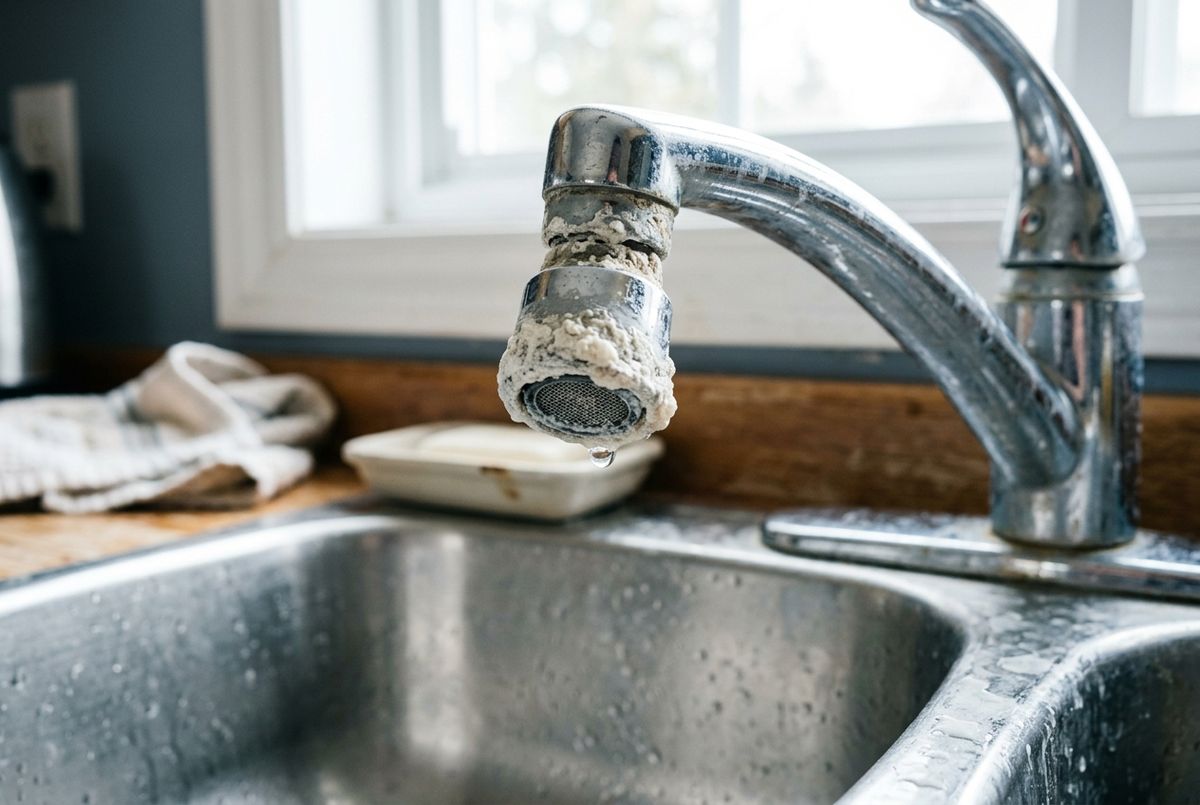
The screen at the end of your kitchen tap silts up with white crust, and so does the mixing cartridge behind the handle. That's why one fixture goes weak while the rest of the house is fine — and why unscrewing an aerator and soaking it in vinegar is the highest-value ten minutes in home plumbing. If everything has gone weak at once, it's a different problem.
It wastes soap and leaves scum
Calcium and magnesium react with soap instead of lathering with it, so you use more detergent to get the same result and you get the grey film on tub walls and shower doors. That's a real running cost and a real cleaning chore, not an aesthetic complaint — it's the thing most people actually buy a softener to solve.
It spots the dishwasher load
Those white specks on glassware are mineral deposits left when hard water evaporates. Rinse aid masks it; it doesn't remove the cause. The same deposits build up on the machine's heating element and jets, which is how a dishwasher quietly gets worse at its job before it fails.
It ages appliances that heat water
Kettles, coffee machines, humidifiers, washing machines, dishwashers — anything with a heating element in contact with our water accumulates scale on that element. Descaling regularly buys you years, and in Calgary it should be on your list rather than something you get around to.
It doesn't cause low pressure on its own
Worth saying because it gets blamed for everything. Scale narrows fixture openings and old galvanized pipe, but modern copper and PEX don't scale shut in the way people imagine. If your whole house has gone weak, look at the pressure reducing valve, a partly-closed main, or corroded galvanized supply first — and if you are not certain which material you have, how to tell what your Calgary home's pipes are made of has the City's own magnet-and-coin test.
Do you need a softener? The honest version
Nobody needs one on health grounds, and it's notable that The City takes no position in favour of them. Its guidance is that consumers should "thoroughly research the various water softener systems available before deciding," it notes salt-based systems "may not be suitable for people on sodium-reduced diets," and it states there are "no known health effects associated with calcium and magnesium minerals in drinking water." That is a public utility deliberately declining to endorse a product category, and it's a more useful signal than any softener company's page.
Source: The City of Calgary — Water quality and water hardness.
So the question isn't need, it's whether it's worth it to you. Here's how we'd frame it — and if you land on yes, the sizing, drain and permit side of the job is covered on our water softener installation page.
- Buy one mainly for the soap, laundry and cleaning. That's the benefit softening reliably delivers — lather, no scum ring, less detergent, softer laundry. If those are your daily irritations, the money does what you want.
- Don't buy one purely to save your hot water tank. It helps, but an annual flush plus an anode rod check around year five protects the tank for a tiny fraction of the cost. Do the cheap thing first and see whether the expensive thing is still worth it.
- Take the sodium caveat seriously if it applies to you. Ion exchange works by trading calcium and magnesium for sodium, so softened water carries more sodium than what came in. Anyone in the house on a sodium-restricted diet should know that. The standard fix is a hard-water tap at the kitchen sink for drinking and cooking — ask for it to be quoted in, not added later.
- Factor the ongoing cost, not just the install. A salt-based unit needs salt bought and carried down the basement stairs, and it discharges brine on each regeneration. Metered-regeneration units use less salt and less water than old timer-based ones, which matters given water and wastewater are both billed by volume in Calgary.
- Watch the plumbing detail. Softened water usually feeds the hot side and interior cold, leaving outdoor taps and often the kitchen cold on hard water. Where the bypass goes is worth deciding before install day.
The salt-free alternatives, assessed honestly
Salt-free "conditioners" — usually template-assisted crystallisation, sometimes sold as scale inhibitors or descalers — work on a different principle. They don't remove anything. They give dissolved minerals a surface to form microscopic crystals on, so the hardness stays suspended in the water rather than plating onto pipe walls and heating elements.
What that means in practice: the water is still just as hard. You will still get spots on glassware, you will still get soap scum, and your laundry will not feel different. What you may get is less scale accumulating on heated surfaces. If you buy one expecting soft water, you'll be disappointed, and some of the marketing does not make this distinction clearly enough.
On the evidence: we'd rather flag this than gloss it. There's lab work supporting scale reduction from template-assisted crystallisation, but the independent, long-run field evidence is thinner than for ion exchange, which has decades of it. Treat salt-free as reasonable when brine or sodium is the deciding factor, and as a weaker bet when what you want is soft water.
Two other things sold in this space: whole-house filters, which handle taste, chlorine and sediment but do nothing for hardness; and magnetic or electronic descalers, where the independent evidence is weak enough that we wouldn't spend money on one.
What it costs — planning ranges only
There is no authoritative public source for water treatment pricing in Calgary, so treat everything here as a planning range for budgeting, not a quote. A Canadian contractor-quote aggregator publishes installed costs of roughly $1,200–$3,500 for a single-tank salt-based softener, $1,500–$4,500 for a salt-free conditioner, and $2,000–$5,500 for a dual-tank system, with premium dealer brands running higher again. Those are self-reported contractor figures across Canada, not Calgary-specific and not independently audited.
Ranges as published by HomeStars — Cost to replace a water softener (2026 guide). Contractor-reported, Canada-wide.
What moves the number on a Calgary job specifically: whether there's a drain and a power outlet near where the unit has to go, whether the incoming line needs re-routing to catch the whole house, and whether you want the hard-water kitchen tap. Get the quote itemised and ask what regeneration setting they'll program — that decides your ongoing salt and water use. Our page on what plumbers charge in Calgary explains why every published rate in this city, ours included, is somebody's self-report.
If you're not buying anything, do these instead
- Flush the hot water tank once a year. That's the single biggest thing you can do about hardness for free. One honest exception: if the tank is well past ten and has never been flushed, disturbing the sediment can start a leak — read this first.
- Soak your aerators in vinegar twice a year. Unscrew, soak overnight, scrub, refit. Restores flow at the tap and takes ten minutes.
- Descale the kettle and coffee machine on a schedule. Not when it looks bad — on a schedule. Elements that stay clean last dramatically longer.
- Run the dishwasher's own descale cycle, or a citric acid cycle. Rinse aid handles the spots you can see; this handles the deposits on the element you can't.
- Wipe the shower glass down. Boring, but scum removed wet is a cloth and scum left to dry is an afternoon with a scraper.
None of that is glamorous and none of it is billable, which is why you don't read it on many plumbing sites. It's also most of the benefit for none of the money. For the wider picture on what goes wrong in Calgary homes and why, start at our main Calgary plumbing guide, or check whether hard water is quietly costing you on the water bill side too.
Want a straight opinion before you buy a softener?
We don't sell water treatment, which means we've got no reason to talk you into one. Tell us what's actually bothering you — scum, tank life, spotting, a weak tap — and we'll tell you whether a softener fixes it or whether something cheaper does. That conversation is free.
Questions Calgary homeowners actually ask
So how hard is Calgary water, in one number?
There isn't one number, and that's the honest answer that most pages about this get wrong. Calgary is fed by two treatment plants and they produce measurably different water. Across 2025, Bearspaw ran about 141–200 mg/L of calcium carbonate and Glenmore ran about 181–274 mg/L. Divide by 17.1 and that's roughly 8–12 grains per gallon on the Bearspaw side and 11–16 on the Glenmore side.
If somebody insists on a single figure, "hard to very hard, and harder in winter" covers it. What you should be suspicious of is any page quoting one precise grains-per-gallon number for the whole city, because that number can only be right for part of it.
How do I find out whether I'm on Bearspaw or Glenmore?
Call 311 and ask. We're not going to guess for you, and neither should anyone else — The City doesn't publish a neighbourhood-by-neighbourhood map of which plant feeds which address, and the plants can share load. Any site telling you your community is definitely on one plant is inventing it.
In practice it matters less than the question implies. The soft end of the Bearspaw range is still hard water by the standard classification, and everything in this article applies either way. It's worth knowing mainly if you're sizing a softener, where the difference between 9 and 15 grains per gallon changes the settings.
Do I actually need a water softener in Calgary?
Need, no. Nobody's health is at stake — The City states there are no known health effects associated with the calcium and magnesium in drinking water, and it does not recommend softeners. It suggests you research the systems available before deciding, which is a fairly pointed way of staying out of the argument.
Want is a different question, and it comes down to what annoys you and what you're protecting. If you're forever descaling the kettle, fighting spots on glassware, and replacing tap cartridges, a softener will genuinely fix that. If your main concern is your hot water tank, a softener helps but so does flushing it and changing the anode rod, for a fraction of the money. One real caveat: salt-based systems add sodium to your water, which The City flags as potentially unsuitable for anyone on a sodium-reduced diet. Most installers put a hard-water tap at the kitchen sink for drinking and cooking to get around that.
Will a softener make my hot water tank last longer?
It should help, because scale in the bottom of the tank is the mechanism that shortens tank life here — it insulates the burner surface, the steel runs hotter than designed, the glass lining cracks. Less scale going in means less scale settling out.
But be careful with the sales pitch. Softening is not a substitute for maintenance, and the cheapest way to protect a tank in this city is still an annual flush plus checking the anode rod around year five. If a salesperson tells you a softener will double your tank's life, ask them for the evidence rather than the brochure. We've written up the whole tank lifespan question here.
What about the salt-free systems? Do those work?
They do something different. Salt-free conditioners — the common type is template-assisted crystallisation — don't remove calcium and magnesium at all. They encourage the minerals to form microscopic crystals that stay suspended instead of plating onto pipe walls and heating surfaces. So your water is still technically just as hard, and you'll still get spots on the glassware and soap that doesn't lather.
The honest position is that the evidence base for them is thinner than for salt-based softening. There's lab work supporting scale reduction on heated surfaces, but nothing like the long track record of ion exchange, and independent field data is scarce. They're a reasonable option if your only concern is scale in the plumbing, if you can't discharge brine, or if the sodium matters to your household. They're a poor choice if you bought one expecting soft-feeling water and better lathering, because they don't deliver that.
Is hard water why my kitchen tap has gone weak?
Very often, yes, and it's the cheapest plumbing fix there is. Scale builds up in the little screen at the end of the spout — the aerator — and it happens faster here than most places. Unscrew it (a cloth in the jaws of pliers saves the chrome), soak it in vinegar overnight, scrub the screen with an old toothbrush, put it back.
If that fixes it, great. If the tap is still weak afterwards, the same scale has probably got into the mixing cartridge inside, which is a bigger job but still a part rather than a plumbing repair. And if the pressure is down all over the house rather than at one tap, it's not the aerators — that's a different diagnosis.